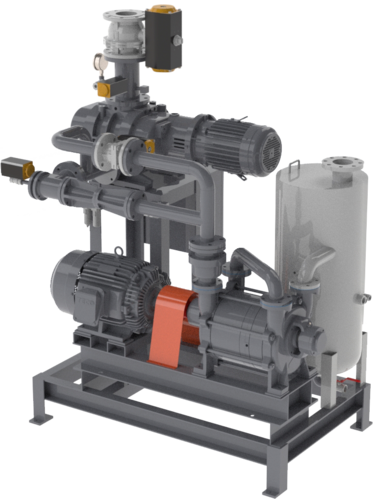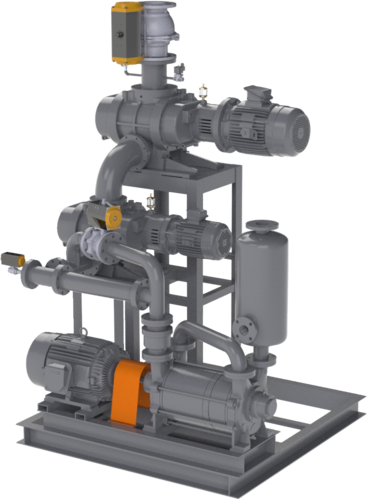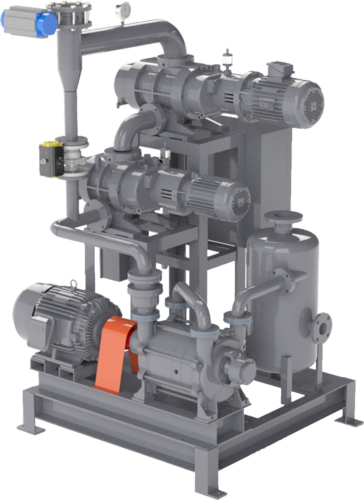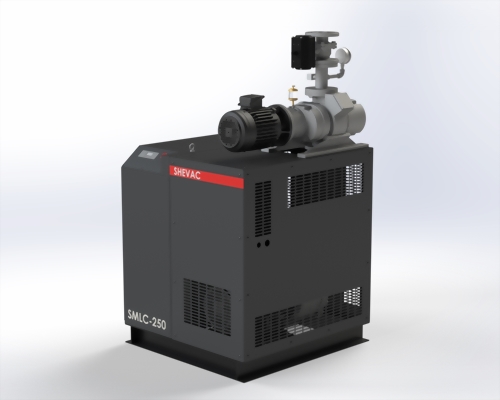
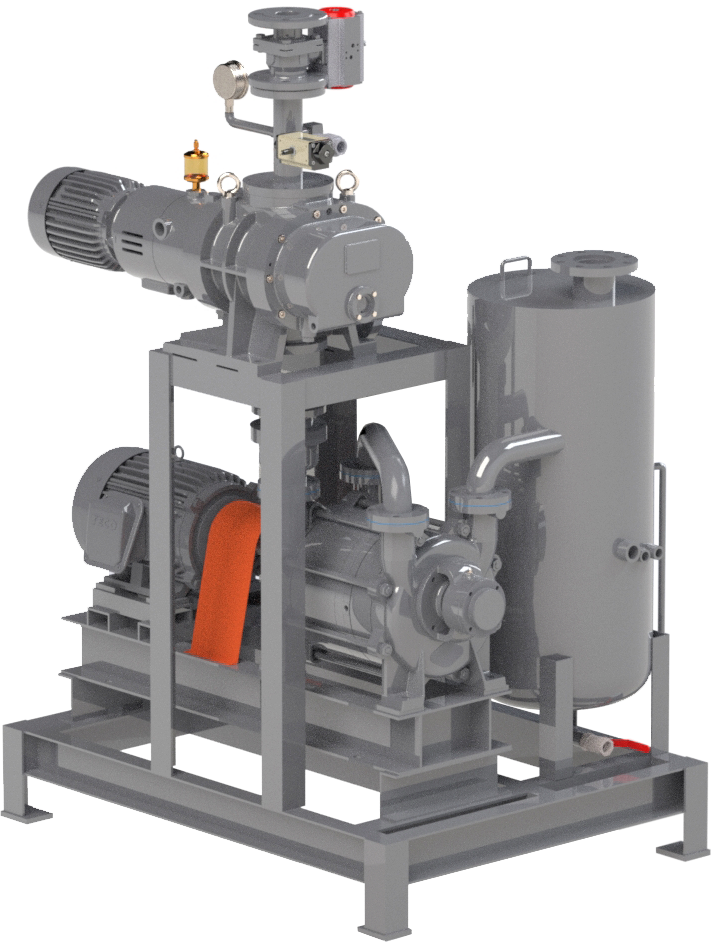
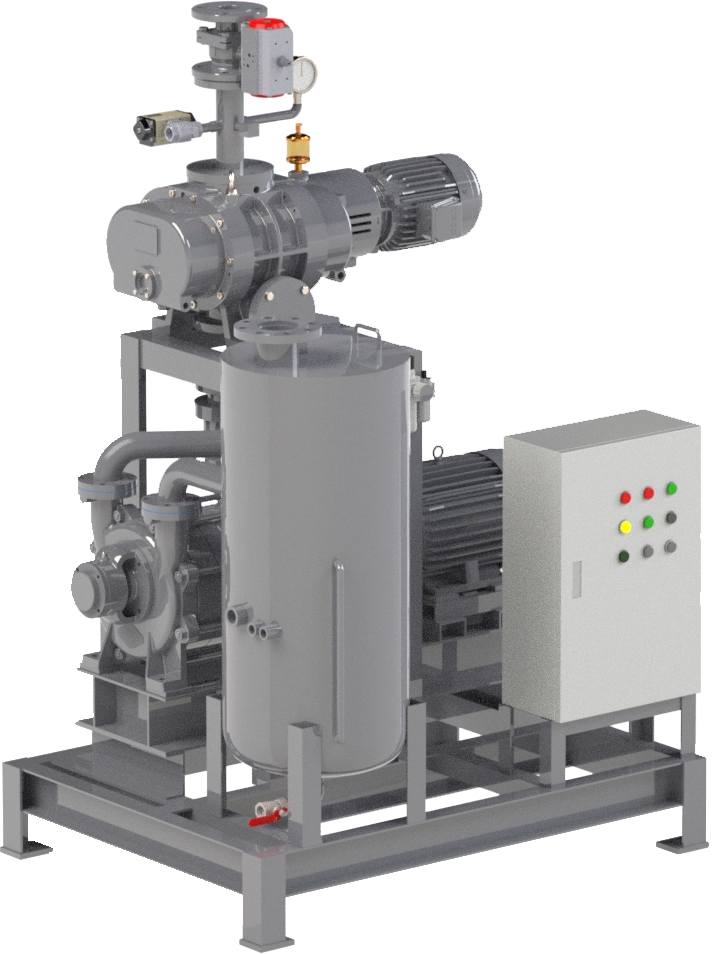
The SML-1 vacuum system consists of a mechanical booster pump combined with a liquid ring vacuum pump, providing high pumping speed and stable operation from rough vacuum to the medium‑high vacuum range, with a final vacuum of up to 3.75 Torr (0.5 kPa[abs]). The system integrates control components such as a vacuum gauge, vacuum switch, relief valve, and pneumatically operated vacuum valve, offering high vacuum level, high quality, shorter operating time, energy savings, low acquisition cost, compact footprint, and easy operation. It is suitable for use as the core medium‑high vacuum exhaust unit in various industrial processes.
What is a vacuum pumping system
A vacuum pumping system is usually
composed of two main parts:
-
Fore‑vacuum pump: For example, an oil‑sealed rotary vane pump or a liquid ring vacuum pump, which starts
pumping from atmospheric pressure and can discharge the gas directly to
atmosphere.
-
Mechanical vacuum booster pump (such
as a Roots pump): This pump provides very high pumping speed in the medium to
high vacuum range, but it cannot compress and discharge gas directly to
atmosphere and therefore needs to work together with a fore‑vacuum pump.
Why combine them into a system
A mechanical vacuum booster pump is
very efficient and offers large pumping speed in the medium to high vacuum
range, but it cannot exhaust directly to atmosphere.
-
Oil‑sealed rotary vane pumps and liquid ring pumps can exhaust directly to
atmosphere, but their efficiency is relatively low in the medium to high vacuum
range.
-
By combining the two (booster pump +
fore‑vacuum pump), the system can both
discharge to atmosphere and maintain high pumping speed in the medium to high
vacuum range, significantly increasing the overall exhaust rate and improving
the achievable vacuum level.
Automation and operation
A complete vacuum exhaust system is
further equipped with instruments such as a vacuum gauge, vacuum switch, relief
valve, pneumatic vacuum valves, and other control components.Through control logic, the system
automatically determines when to start or stop the booster pump, so the
operator only needs to operate the main unit or control panel, without manually
calculating or judging the proper timing and procedure for starting the
mechanical booster pump, thus achieving stable and simplified automated
operation.
FORMANCE RANGES OF MECHANICAL BOOSTER VACUUM PUMP
|
型 式 Model |
排氣速度 Capacity m³/h |
最 終 壓 力 Ultimate Press.Torr |
後 段 幫 浦 Backing Pumps |
總 馬 力 Total Power HP |
口 徑 mm(in) |
|
|
Inlet |
Outlet |
|||||
|
SMB65 |
300 |
2(0.2) |
SWV-5D |
2 + 5 |
65 (2.5) |
50(2) |
|
0.2 |
SOV-5DW |
2+5 |
50(2) |
|||
|
SMB80 |
500 |
2(0.2) |
SWV-7D |
3 + 7.5 |
80 (3) |
50(2) |
|
0.2 |
SOV-5DW |
3+5 |
50(2) |
|||
|
SMB100 |
700 |
2(0.2) |
SWV-10D |
5 + 10 |
100 (4) |
50(2) |
|
0.2 |
SOV-5DW |
5+5 |
50(2) |
|||
|
0.1(0.01) |
SMB65+SWV-5D |
5+3+5 |
50(2) |
|||
|
SMB125A |
1000 |
2(0.2) |
SWV-15 |
7.5 + 15 |
125 (5) |
50(2) |
|
0.2 |
SOV-7DW |
7.5+7.5 |
50(2) |
|||
|
0.1(0.01) |
SMB80+SWV-7D |
7.5+3+7.5 |
50(2) |
|||
|
SMB125 |
1500 |
2(0.2) |
SWV-20 |
10 + 20 |
125 (5) |
50(2) |
|
0.2 |
SOV-10DW |
7.5+10 |
50(2) |
|||
|
0.1(0.01) |
SMB100+SWV-15 |
7.5+5+15 |
50(2) |
|||
|
SMB150 |
2000 |
2(0.2) |
SWV-700 |
15 + 40 |
150 (6) |
80(3) |
|
0.2 |
SOV-20DW |
10+20 |
50(2) |
|||
|
0.1(0.01) |
SMB125A+SWV-20 |
10+7.5+20 |
50(2) |
|||
|
SMB200A |
3200 |
0.1(0.01) |
SMB125A+SWV-600 |
15+7.5+30 |
200 (8) |
80(3) |
|
0.2 |
SOV-700W |
15+40 |
80(3) |
|||
|
SMB200 |
4100 |
0.1(0.01) |
SMB125+SWV-700 |
20+10+40 |
200 (8) |
80(3) |
|
0.2 |
SOV-900W |
20+40 |
100(4) |
|||
|
SMB250 |
5400 |
0.1(0.01) |
SMB150+SWV-900 |
25+10+40 |
250 (10) |
100(4) |
|
0.2 |
SOV-900W |
20+50 |
100(4) |
|||
|
SMB300A |
7500 |
0.2 |
SOV-1300W |
30+50 |
300(12) |
100(4) |
|
SMB300 |
9000 |
0.2 |
SOV-1300W |
30+60 |
300(12) |
100(4) |
Wide applicable pressure range:
By sharing the workload between the fore‑vacuum pump and the mechanical booster pump, the usable range extends from rough vacuum to medium and high vacuum, and an atmospheric booster can be optionally added to further improve the ultimate pressure.
High pumping speed and reduced evacuation time:
In the medium to high vacuum range, the mechanical booster pump provides a high exhaust rate, significantly shortening the time required to reach the working vacuum from atmosphere and increasing equipment throughput.
Easy automation and operation:
The system integrates a vacuum gauge, vacuum switch, pneumatic vacuum valves, and protection logic, enabling automatic start and stop of the booster pump according to the pressure range, so the operator does not need to judge the timing manually.
Energy saving and cost reduction:
Using the most suitable pump in each pressure range reduces unnecessary energy consumption, and compared with a single large‑pump solution, offers both lower capital cost and lower operating cost.
Modular design and customization flexibility:
Depending on the actual process requirements, different pumping speeds, ultimate pressures, and fore‑pump types (liquid ring or oil‑sealed rotary vane) can be selected, and the system can be expanded with multiple units in parallel or with an atmospheric booster to meet higher pumping speed or lower pressure demands.
The SML-1 vacuum pumping system is suitable for a wide range of industrial processes that require medium to high vacuum with relatively large pumping capacity, such as vacuum distillation, vacuum degassing, vacuum dewatering, vacuum drying, vacuum deodorization, vacuum cooling, and vacuum concentration in various thermal treatment or separation processes. It is also commonly used in applications such as vacuum impregnation, vacuum metallurgy, vacuum casting, vacuum evaporation coating, vacuum sintering, vacuum insulation, and vacuum crystallization in the metal, materials, and insulation industries, as well as in the optical industry, cryogenic engineering, vacuum research laboratories, and vacuum freeze‑drying processes that demand a stable medium‑high vacuum. For wet processes containing water vapor, solid particles, or corrosive gases, the system can be combined with a liquid ring fore‑vacuum pump to provide a versatile, highly efficient vacuum and reduced‑pressure source with enhanced resistance to harsh process conditions.